Authentik identity platform Authentik identity platform

Planning Authentik: Centralized Identity for a Homelab

TL;DR I am deploying Authentik as a centralized identity provider for my k3s cluster. It replaces the current OAuth2 Proxy setup with proper SSO, federates Google as a social login source, and introduces group-based RBAC (admins, writers, readers) across all services. The migration is phased – public services first via Traefik forwardAuth, then internal services via native OIDC, then proxy-protected apps that have no OIDC support. OAuth2 Proxy stays in git for instant rollback. This post covers the architecture, the user model, the edge security design, and the gotchas I expect to hit. ...

March 27, 2026 · 7 min · zolty
Jellyfin hardware stress tester Jellyfin hardware stress tester

Stress Testing GPU Transcoding in Kubernetes with JF_hw_stress

TL;DR JF_hw_stress is a headless transcoding stress tester that answers one question: how many concurrent transcode streams can your GPU actually handle before quality degrades? It runs escalating FFmpeg transcodes against real media files using VAAPI hardware acceleration, measures FPS ratios, and outputs a JSON report. I run it as a Kubernetes Job on the same k3s cluster from Cluster Genesis, scheduled exclusively on the GPU node (Intel UHD 630). The job auto-deletes after 10 minutes so it does not accumulate stale pods. ...

March 27, 2026 · 6 min · zolty
Homelab infrastructure overview Homelab infrastructure overview

Homelab State of the Union: 42 Namespaces and Counting

TL;DR The homelab runs 42 Kubernetes namespaces across 7 nodes (3 control plane, 4 workers) on 4 Lenovo ThinkCentre M920q mini PCs running Proxmox VE. This post is the result of a full infrastructure audit — reconciling what’s actually running against what’s documented, catching version drift, and noting what’s been added, removed, or broken since the last check. Compute Four Lenovo ThinkCentre M920q nodes form the physical layer: Host CPU RAM NVMe Role pve1 i5-8500T 32GB 512GB 1 server VM + 1 agent VM pve2 i5-8500T 32GB 512GB 1 server VM + 1 agent VM pve3 i5-8500T 32GB 512GB 1 server VM + 1 agent VM pve4 i7-8700T 32GB 512GB 1 agent VM (GPU passthrough) The k3s cluster runs v1.34.4+k3s1 with embedded etcd for HA. All 7 nodes report Ready. Server VMs get 2 cores and 6GB each — just enough for etcd and the API server. Agent VMs are beefier: 6 cores and 22GB on pve1-3, 12 cores and 28GB on pve4. ...

March 26, 2026 · 6 min · zolty
OpenClaw multi-user AI gateway OpenClaw multi-user AI gateway

OpenClaw Multi-User: Privacy, Dual AI Backends, and Per-User Cost Tracking

TL;DR Multi-user AI chat with privacy guarantees, dual model providers (Anthropic direct API + AWS Bedrock via LiteLLM), and per-user cost tracking via Prometheus and Grafana. The admin cannot read other users’ conversations. Three family members authenticate via Google OAuth, each getting isolated chat sessions. Anthropic serves as the primary model provider with lower latency, and Bedrock via LiteLLM acts as a fallback. Per-user spend is tracked through LiteLLM’s Prometheus metrics without any surveillance of conversation content. This is a follow-up to the OpenClaw on k3s setup post. ...

March 25, 2026 · 13 min · zolty
Linkerd service mesh evaluation for homelab Kubernetes Linkerd service mesh evaluation for homelab Kubernetes

Linkerd Service Mesh: Why I'm Not Deploying It Yet (But Have a Plan Ready)

TL;DR I spent time evaluating Linkerd — the CNCF graduated service mesh — for my homelab k3s cluster. The conclusion: it’s an impressive piece of engineering with genuinely useful features like automatic mTLS, post-quantum cryptography, and per-service observability. But for a cluster with ~20 workloads and a single operator, the operational overhead outweighs the benefits today. I’ve written a complete deployment plan so I can adopt it quickly when the cluster grows to the point where it makes sense. ...

March 24, 2026 · 8 min · zolty
OpenClaw AI gateway on k3s OpenClaw AI gateway on k3s

OpenClaw on k3s: Replacing Open WebUI with a Lighter AI Gateway

TL;DR I replaced Open WebUI with OpenClaw – a lighter, WebSocket-based AI assistant gateway that installs from npm, supports multiple chat channels (web, Telegram, Discord, WhatsApp), and deploys on k3s as a single Deployment with a custom Docker image. The primary model provider is Anthropic’s direct API (Claude Sonnet 4.5), with LiteLLM/Bedrock as a fallback. The biggest deployment lesson: OpenClaw binds to loopback by default, which makes it invisible to Kubernetes Services and health probes. The fix is --bind lan, which requires a gateway token for authentication. ...

March 23, 2026 · 13 min · zolty
Harbor container registry Harbor container registry

Ditching AWS ECR for Self-Hosted Harbor: Why and How

TL;DR AWS ECR tokens expire every 12 hours. Every time the cron job that refreshes the pull secret fails, image pulls break cluster-wide. Docker Hub’s anonymous rate limit (100 pulls/6 hours) started hitting during CI builds that pull nginx:alpine and python:3.12-slim. I replaced both with self-hosted Harbor for container images and Gitea for package registries (PyPI, npm), backed by NFS on the NAS, deployed via Ansible and Helm, with Trivy vulnerability scanning on push. Thirteen CI workflows were updated in a single commit. Pull secrets never expire. Images never rate-limit. Monthly ECR cost drops to zero. ...

March 21, 2026 · 5 min · zolty
One month retrospective One month retrospective

One Month Retrospective: From Bare Metal to Production Platform

TL;DR One month ago, I had three empty Lenovo ThinkCentre M920q mini PCs and a Proxmox installer USB. Today, the cluster runs 8 Kubernetes nodes, 15+ applications, full observability with Prometheus and Grafana, AI-powered alert analysis, self-hosted CI/CD, 10GbE networking, and a 3D printer fabricating custom hardware. Total hardware cost: under $800. This post traces the entire journey, day by day, including the things that went wrong. ...

March 21, 2026 · 10 min · zolty
Jellyfin HA on Kubernetes Jellyfin HA on Kubernetes

Jellyfin HA on Kubernetes: Redis-Backed Transcode Session Failover

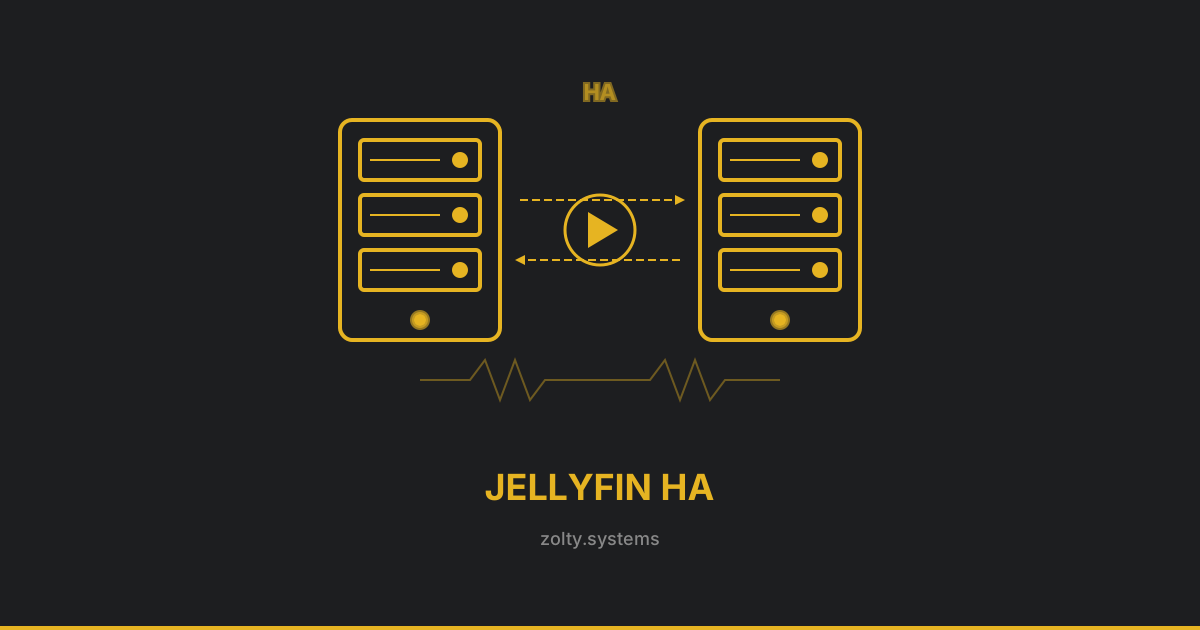
TL;DR Jellyfin dies mid-stream when a Kubernetes pod restarts because all transcode state is in-memory. I forked it, added a Redis-backed ITranscodeSessionStore, and wired in atomic lease-based pod takeover. The fork is at github.com/ZoltyMat/jellyfin-ha, and I also published a repo-level diff document at docs/FORK-DIFF.md showing exactly what changed versus upstream Jellyfin. Single-instance deployments need zero config changes because it falls back to a no-op store transparently. The Problem Jellyfin is great. It’s also built with the assumption that exactly one server instance is running at a time. Transcode state — which pods are running FFmpeg, what segments have been written, who owns a given play session — lives entirely in memory. When the process dies, that state is gone. ...

March 14, 2026 · 7 min · zolty
Jellyfin HA project retrospective Jellyfin HA project retrospective

What's Still Broken and What Comes Next

TL;DR Over the last six posts, I’ve documented converting Jellyfin from a single-process media server into a two-replica, PostgreSQL-backed, sticky-session-coordinated deployment on k3s. Five of six failover tests passed cleanly. The key result: zero-downtime failover — killing a pod doesn’t take down the service. Users on the surviving replica see no interruption; displaced users reconnect in seconds. Node maintenance no longer kills Jellyfin for the household. But this project isn’t finished, and some problems can’t be solved with this architecture. This final post is an honest inventory of what’s still broken, what was deferred, and what the path forward looks like. ...

March 12, 2026 · 10 min · zolty

Affiliate Disclosure: Some links on this site are affiliate links (Amazon Associates, DigitalOcean referral). As an Amazon Associate, I earn from qualifying purchases. This does not affect the price you pay or my editorial independence — I only recommend products and services I personally use and trust.