Week of March 23 retrospective

Week of March 23: Security Patches, AI Tooling, and Defending the Homelab on Reddit

TL;DR Busy week. Three CVE patches shipped on the same day. OpenClaw stabilized with OpenRouter support and a cost exporter. The Wiki.js fork with Mermaid 11 went live after clearing a Trivy scan. PiKey — a Raspberry Pi that pretends to be a Bluetooth keyboard — shipped as a side project. A self-hosted GitHub Actions cache server cut CI restore times from minutes to seconds. And a Reddit comment defending “I use Claude to manage my infrastructure” turned into five new blog posts and a documentation sprint. ...
March 29, 2026 · 6 min · zolty
K3s stability improvements

Two Months of K3s Stability Improvements

TL;DR Over the past two months, I have made a series of stability improvements to my k3s homelab cluster. The biggest wins: migrating from AWS ECR to self-hosted Harbor (eliminating 12-hour token expiry), fixing recurring Grafana crashes caused by SQLite corruption on Longhorn, recovering pve4 after a failed LXC experiment, hardening NetworkPolicies to close gaps in pod-to-host traffic rules, and patching multiple CVEs across the media stack. The cluster now runs 7/7 nodes on k3s v1.34.4, all services monitored, all images pulled from Harbor with static credentials that never expire. ...

March 27, 2026 · 8 min · zolty
CI/CD pipeline for blog deployment on k3s

This Blog Deploys Itself: Self-Hosted CI/CD on k3s with GitHub ARC

TL;DR The blog is deployed by GitHub Actions runners running inside the same k3s cluster it’s talking about. A push to main with content under hugo/ triggers a build, a two-pass S3 sync, and a CloudFront invalidation. A daily 06:00 UTC cron handles future-dated posts so I can commit a backlog and let them drip out on schedule. After every successful deploy, a Playwright job kicks off and scans the live site for broken links, visual regressions, and security header compliance. The whole thing runs on eight self-hosted amd64 runners managed by GitHub’s Actions Runner Controller (ARC) in the cluster. Not a single managed CI minute gets billed. ...

March 26, 2026 · 7 min · zolty
Linkerd service mesh evaluation for homelab Kubernetes

Linkerd Service Mesh: Why I'm Not Deploying It Yet (But Have a Plan Ready)

TL;DR I spent time evaluating Linkerd — the CNCF graduated service mesh — for my homelab k3s cluster. The conclusion: it’s an impressive piece of engineering with genuinely useful features like automatic mTLS, post-quantum cryptography, and per-service observability. But for a cluster with ~20 workloads and a single operator, the operational overhead outweighs the benefits today. I’ve written a complete deployment plan so I can adopt it quickly when the cluster grows to the point where it makes sense. ...

March 24, 2026 · 8 min · zolty
One month retrospective

One Month Retrospective: From Bare Metal to Production Platform

TL;DR One month ago, I had three empty Lenovo ThinkCentre M920q mini PCs and a Proxmox installer USB. Today, the cluster runs 8 Kubernetes nodes, 15+ applications, full observability with Prometheus and Grafana, AI-powered alert analysis, self-hosted CI/CD, 10GbE networking, and a 3D printer fabricating custom hardware. Total hardware cost: under $800. This post traces the entire journey, day by day, including the things that went wrong. ...

March 21, 2026 · 10 min · zolty
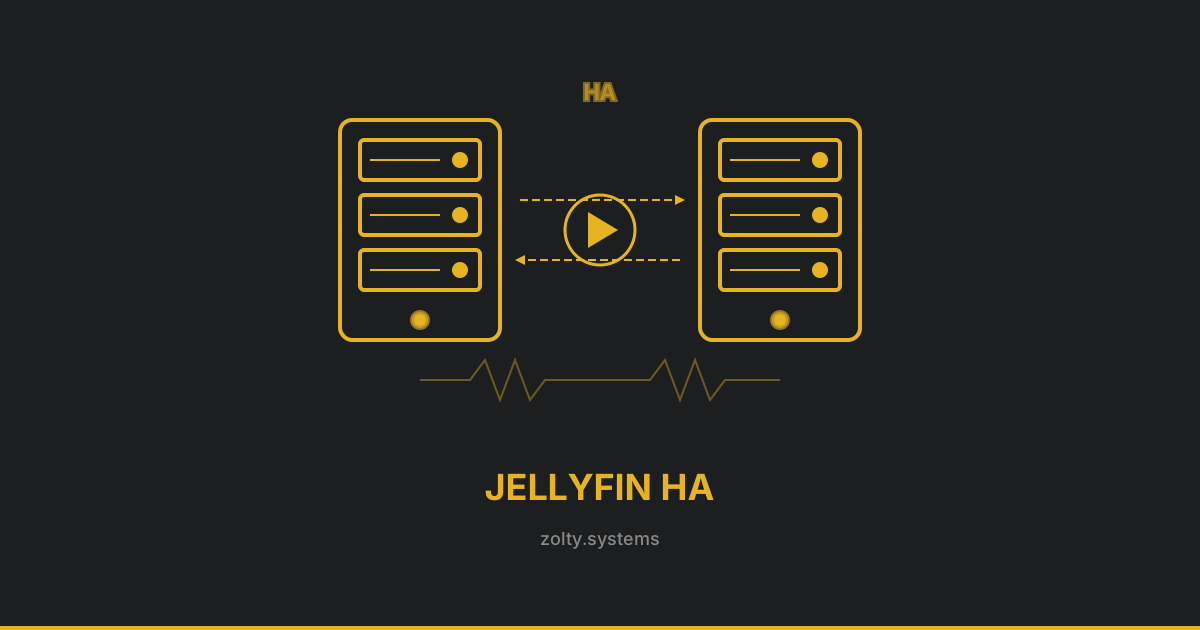
Jellyfin HA on Kubernetes

Jellyfin HA on Kubernetes: Redis-Backed Transcode Session Failover

TL;DR Jellyfin dies mid-stream when a Kubernetes pod restarts because all transcode state is in-memory. I forked it, added a Redis-backed ITranscodeSessionStore, and wired in atomic lease-based pod takeover. The fork is at github.com/ZoltyMat/jellyfin-ha, and I also published a repo-level diff document at docs/FORK-DIFF.md showing exactly what changed versus upstream Jellyfin. Single-instance deployments need zero config changes because it falls back to a no-op store transparently. The Problem Jellyfin is great. It’s also built with the assumption that exactly one server instance is running at a time. Transcode state — which pods are running FFmpeg, what segments have been written, who owns a given play session — lives entirely in memory. When the process dies, that state is gone. ...

March 14, 2026 · 7 min · zolty
AI-driven Kubernetes incident response — seven alerts resolved

Seven Alerts, Three Bugs, One AI Debug Session: A Kubernetes Incident Report

TL;DR A routine cluster health check surfaced seven simultaneous issues. Most were transient — Longhorn self-healed its replica fault, Prometheus recovered behind it, a stale manually-created Job was deleted in one command, and a liveness probe blip fixed itself. The real work was dnd-backend, which had been in CrashLoopBackOff and turned out to contain three separate bugs layered on top of each other. The AI identified all three during a single debugging session, authored the fixes across three PRs, and the service came up 1/1 Running with all 18 database tables created on the first boot after the final merge. ...

March 4, 2026 · 8 min · zolty

Reference: k3s Homelab — AI Lessons Learned

Context: This is the live docs/ai-lessons.md from the home k3s cluster repository, referenced extensively across posts on this blog — starting with AI Memory System and GitHub Copilot Setup Guide. Every entry exists because its absence caused a production incident. Personal identifiers and internal domains have been replaced with generic placeholders. Updated: 2026-03-03 Rules discovered through production breakage. Each entry prevents recurrence of a specific failure. Update this file whenever a new non-obvious failure pattern is discovered. ...

March 2, 2026 · 81 min · zolty
Monitoring goes blind — Longhorn storage corruption incident report

When Monitoring Goes Blind: A Longhorn Storage Corruption Incident

TL;DR Grafana went completely dark for about 26 hours on my home k3s cluster. Two things broke simultaneously: Loki entered CrashLoopBackOff, and Prometheus silently stopped ingesting metrics — its pods showed as healthy and 2/2 Running the whole time. The actual cause was Longhorn’s auto-balancer migrating replicas onto a freshly-added cluster node (k3s-agent-4) that had unstable storage during its first 48 hours. The replica I/O errors propagated directly into the workloads, corrupting mid-write files: a Prometheus WAL segment and a Loki TSDB index file. Both required offline surgery via a busybox pod to delete the corrupted files before the services could recover. ...

February 25, 2026 · 8 min · zolty
k3s cluster upgrade from v1.29 to v1.34

Upgrading k3s Across Five Minor Versions: v1.29 to v1.34 on a Homelab Cluster

TL;DR Upgraded a production k3s cluster from v1.29.0+k3s1 to v1.34.4+k3s1 across 8 nodes — 3 control plane servers, 4 amd64 worker agents, and 1 arm64 Lima VM agent. The upgrade stepped through every minor version (v1.29 → v1.30 → v1.31 → v1.32 → v1.33 → v1.34) with etcd snapshots between each step. Longhorn was upgraded from v1.6.0 to v1.8.2 in two stages (v1.7.3 as an intermediate step). SSH was broken to all cluster nodes, so the entire upgrade was done via Proxmox QEMU Guest Agent (qm guest exec) and Lima CLI (limactl shell). Discovered that k3s intentionally pins Traefik to v2.11.24 even when bundling Helm chart v27 — Traefik v3 migration is a separate effort. ...

February 22, 2026 · 10 min · zolty

Affiliate Disclosure: Some links on this site are affiliate links (Amazon Associates, DigitalOcean referral). As an Amazon Associate, I earn from qualifying purchases. This does not affect the price you pay or my editorial independence — I only recommend products and services I personally use and trust.