Multiple Claude sessions posting to a shared Mattermost channel Multiple Claude sessions posting to a shared Mattermost channel

Coordinating 3-5 parallel Claude sessions through a shared Mattermost channel

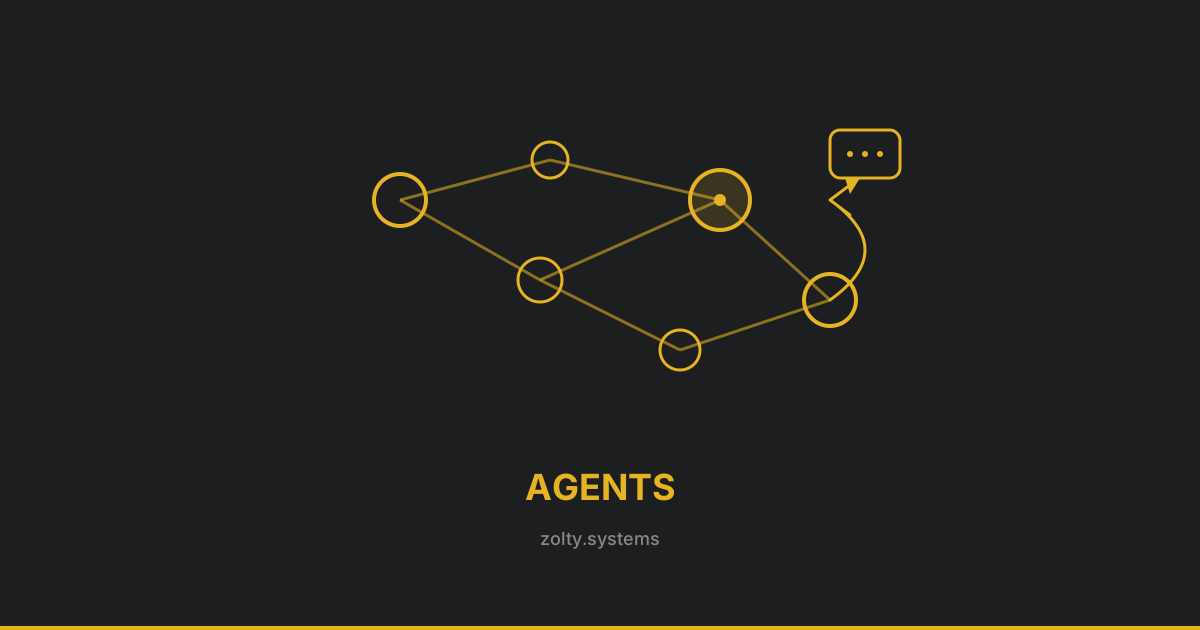
TL;DR I run 3-5 Claude Code sessions in parallel at staggered cadences. They coordinate through a shared #mat-claude-sessions Mattermost channel plus a small coordination board file. Each session announces what it’s about to touch, claims it, and announces when it’s done. Conflicts are rare; throughput is dramatically higher than running one session at a time and waiting. Why parallel A single Claude Code session running a long task — refactor across a few repos, work through a debugging session, draft a blog post — is mostly me waiting. The model is fast but tasks are bounded by my decisions, my reviews, and my edits. If I’m waiting on Session A to finish a build, Session B can be drafting something unrelated. Session C can be running a slow eval. The bottleneck stops being the model and becomes my own attention rotation. ...

May 9, 2026 · 4 min · zolty
Agentic Claude processes reporting back from long-running OpenClaw workers Agentic Claude processes reporting back from long-running OpenClaw workers

Giving Claude the ability to talk back: agentic long-running processes in OpenClaw

Heads up: this post mentions Claude. If you want to try it, I've got a referral link — it gives us both a bit of extra credit, no pressure: claude.ai via my referral. TL;DR Most AI tooling still treats an LLM like a search bar — you prompt, it answers, the loop ends. Useful, but not what I wanted. For my homelab’s ops + trading intelligence platform (OpenClaw), I needed agents that could run for hours, do real work against a real cluster, and then tap me on the shoulder when they found something I should see. Claude turned out to be the model I kept coming back to for the “thinking” layer — it’s both comfortable with long tool-use chains and happy to write structured output a human won’t need to decode. This is a tour of how I’ve actually wired that up: k3s CronJobs doing the heavy lifting, LiteLLM as the routing layer, Slack as the interrupt bus, and named cat-bot personas so I can tell at a glance who’s knocking. ...

April 21, 2026 · 11 min · zolty
OpenClaw vs Claude Code architecture comparison OpenClaw vs Claude Code architecture comparison

OpenClaw vs Claude Code: An Architectural Comparison

TL;DR Someone leaked the Claude Code source on GitHub. OpenClaw, the open-source AI coding agent with 346k stars, solves the same problem with a completely different architecture. I compared both codebases at the structural level. The verdict: these are independent implementations that converge on the same tool-use patterns because that is what the problem demands — not because one copied the other. Background In late March 2026, a repository appeared on GitHub containing what appears to be the full source code for Anthropic’s Claude Code — the terminal-based AI coding agent I wrote about switching to last month. The repo has two commits (“init” and “add readme”), 1,932 files, and weighs 43MB. ...

April 2, 2026 · 11 min · zolty
Operation Moonshot - Linux in Rust Operation Moonshot - Linux in Rust

Operation Moonshot: Can Claude Rewrite Linux in Rust?

TL;DR The Linux kernel is 36 million lines of C. Rust has been slowly entering the kernel since Linux 6.1, but progress is measured in individual drivers and abstractions – a few thousand lines per release cycle. What if you skipped the incremental approach and asked Claude to rewrite major subsystems wholesale? I spent a weekend scoping this as a serious project plan: breaking the kernel into translatable units, estimating token costs, identifying the hard walls, and testing Claude’s ability to produce correct Rust translations of real kernel C. The conclusion: Claude can translate isolated, well-bounded kernel modules with surprising accuracy. It cannot translate the kernel. The difference between those two statements is the entire lesson. ...

March 22, 2026 · 14 min · zolty
Regulatory compliance with Claude Regulatory compliance with Claude

Using Claude to Start Your Regulatory Compliance Journey

TL;DR Regulatory compliance – SOC 2, GDPR, HIPAA, PCI DSS, ISO 27001 – looks impenetrable from the outside. Hundreds of controls, dozens of policy documents, auditor-specific jargon, and no clear starting point. Before you hire a $300/hour consultant or drop $50K on a GRC platform, you can use Claude to do the initial heavy lifting: map which frameworks apply to your business, identify your biggest gaps, draft policies that match your actual infrastructure, build a prioritized remediation plan, and prepare for your first auditor conversation. This post walks through the process I used, with real prompts and outputs, to go from “we probably need SOC 2” to a concrete compliance roadmap in a single afternoon. ...

March 22, 2026 · 13 min · zolty
AI pair programming AI pair programming

Five Projects in One Day: What AI Pair Programming Actually Looks Like

TL;DR On March 21, I shipped meaningful work across five repositories in a single day: a 13,674-line stock trading platform from scratch, a Harbor container registry replacing AWS ECR across 13 CI workflows, API key authentication and an HA proxy for digital signage, inventory sell signals for a trading card tracker, and an OpenClaw cost optimization that killed an idle token burn. Every commit was co-authored with Claude. This post breaks down the mechanics of how that actually works – the prompting patterns, the failure modes, the things I would not let the AI do, and the real throughput multiplier. ...

March 22, 2026 · 6 min · zolty
Claude Code vs GitHub Copilot Claude Code vs GitHub Copilot

Why I Switched from GitHub Copilot to Claude Code Max

TL;DR GitHub Copilot is more capable than most people give it credit for. I used it heavily – not just for autocomplete, but for multi-file edits, chat-driven debugging, and workspace-aware refactoring. After a year of intensive Copilot usage and a month with Claude Code Max ($100/month for the Max plan with Opus), I moved my primary workflow to Claude Code for infrastructure and backend work. The reason is not that Copilot cannot do these things – it is that Claude Code is faster and I can hand it a task and let it run without babysitting. Copilot still wins for inline code completion in the editor. Claude Code wins when I want to describe a goal and walk away while it executes. ...

March 22, 2026 · 11 min · zolty
Two AIs managing a GitHub repository via issues and pull requests Two AIs managing a GitHub repository via issues and pull requests

Two AIs, One Codebase: Using Local Copilot to Direct GitHub Copilot via Issues and PRs

TL;DR A 109-day project plan. One day of actual work. Eight hours of active pipeline time. The key was treating planning and implementation as two separate AI-driven phases: spend an evening getting the plan right by routing it through multiple models, then let Claude Sonnet 4.6 implement it autonomously overnight via GitHub Copilot’s cloud agent while you sleep. This is the full playbook — planning phase included. The Project This came out of building dnd-multi, a full-stack AI Dungeon Master platform: FastAPI backend, Next.js 15 frontend, a Discord bot, LiveKit voice, and AWS Bedrock integration. Seven feature phases, a plan projected to take until June 19. ...

March 2, 2026 · 11 min · zolty
GitHub Copilot setup guide with AI skills and memory GitHub Copilot setup guide with AI skills and memory

Getting Started with GitHub Copilot: What Actually Works

TL;DR A $20/month GitHub Copilot subscription gives you Claude Sonnet 4.6, GPT-4o, and Gemini inside VS Code. Out of the box it’s useful. With a proper instruction setup — a copilot-instructions.md file, path-scoped rules, and skill documents — it becomes something you actually rely on. Most of the posts on this blog were built with this toolchain, mostly in the context of my k3s cluster, but the patterns apply anywhere. This is how I have it set up. ...

March 1, 2026 · 12 min · zolty
AI context window audit AI context window audit

When Your AI Memory System Eats Its Own Context Window

TL;DR The AI memory system I built three weeks ago started causing the problem it was designed to solve: context window exhaustion. Five generic Claude skills — duplicated identically across all 5 repositories in my workspace — consumed 401KB (~100K tokens) of potential context. The gh-cli skill alone was 40KB per copy, accounting for 42% of all skill content. I ran a full audit, deleted 25 duplicate files, and documented the anti-pattern to prevent recurrence. ...

February 23, 2026 · 6 min · zolty

Affiliate Disclosure: Some links on this site are affiliate links (Amazon Associates, DigitalOcean referral). As an Amazon Associate, I earn from qualifying purchases. This does not affect the price you pay or my editorial independence — I only recommend products and services I personally use and trust.