TL;DR
- Claude now has hosted artifacts with sharing, comments and shared data of their own. I still run my own share host, and I have a reason that isn’t nostalgia: the pages, the comment threads and the access list are all things Claude can reach through one MCP connector I control.
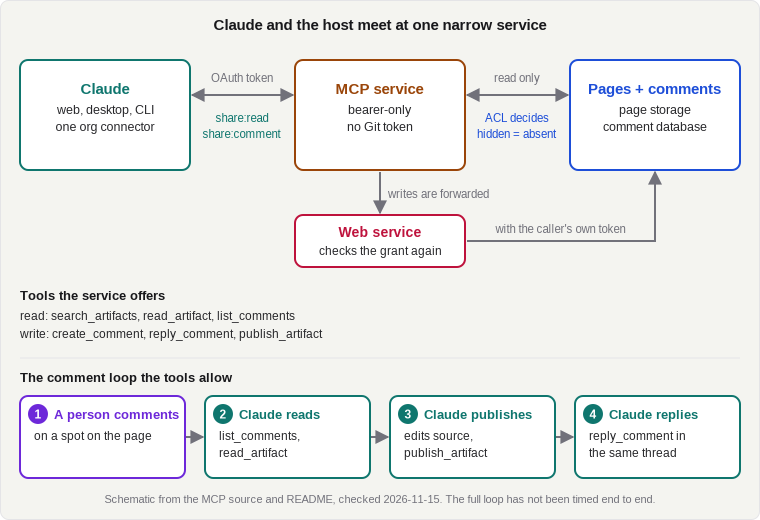
- The MCP server lets Claude search and read pages, list comments, post a comment, reply to a thread, and (since 2026-11-15) publish a page. Write access is a separate OAuth scope, and the server holds no token for my Git host or my identity provider’s admin API.
- My argument for self-hosting is speed of change: when a fix or a UI idea matters to me, I can ship it the same day. The commit log has examples, and I’ll show them. It also has examples of me being wrong.
- It isn’t free. I’m the security team, the backup plan and the on-call for a thing with one database replica. If you don’t want that job, a hosted artifact is the correct choice.
What I’m comparing
I wrote the first post about this host when it was an access-control problem: I made HTML with Claude and had no way to give one page to one person. That story was about ACLs, forms that commit to Git, and status pages. I won’t redo it.
This one is narrower. Hosted artifacts have moved a lot since September. From the tool docs in my own session, they can now take comments, hold shared data and be watched by Claude, which is most of what I originally built. I haven’t compared the two feature by feature, so treat that as “closer than it was,” not a verdict.
So the useful question isn’t “can the hosted one do what mine does.” It’s “what does owning the host change for me?” I came up with three answers.
1. The comment loop runs through MCP
Every page on my host opens in a viewer: the page on the left, comment threads on the right. You can draw a box, drop a pin or scribble on a spot and the comment is anchored there. Threads resolve and fold away.
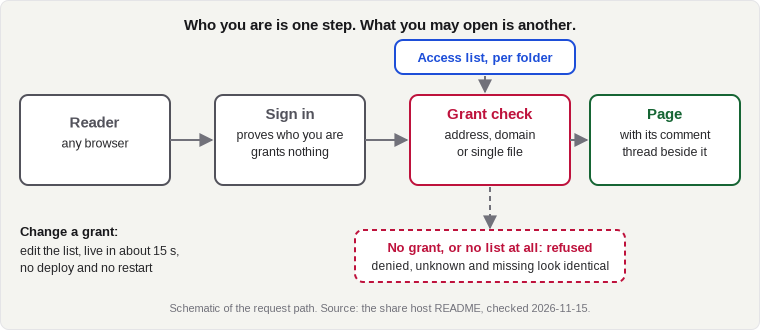
Before the MCP part, here is the path every request takes, because the MCP server inherits it rather than replacing it.
The MCP server is a separate service from the website. It is Bearer-only, so a browser cookie never works on it. These are the tools I verified in the source today:
| Job | Tools |
|---|---|
| Who am I, what can I see | whoami, list_spaces, list_artifacts |
| Find and read | search_artifacts, read_artifact, list_tags, set_artifact_tags |
| Comments | list_comments, create_comment, reply_comment |
| Publish and organize | publish_artifact, organize_folders |
| Access | set_access, set_space_publisher, edit_group |
| Page monitoring | a small lease-based set of tools, off unless a page opts in |
A few details that took me a while to decide on:
- Scopes. A client must ask for
share:read. Writing comments needsshare:commenton top, and only works if that person already has the capability on the page. A scope never grants access by itself. The ACL still decides. - Retries are safe. Creating a comment or a reply is idempotent, so an agent that times out and tries again doesn’t post twice.
- Hidden means absent. A private thread isn’t greyed out for the wrong reader. It isn’t there, and it isn’t in the counts.
- The server holds only what it needs. It has read-only access to the page storage and no Git token. A write is forwarded to the web service with the caller’s own token, and the web service checks it again.
The loop this enables is simple. Someone leaves a comment on a page. Claude lists the threads, reads the page, edits the source, republishes it, and replies in the thread so the human sees the answer where they asked the question. I have run the human-comment half of this for real: in October a comment on a status page asking what each test track measured became a plain-language description in the page generator within about four hours, and the commit message names the comment. That story is in the earlier post. I have not benchmarked the full read, publish and reply loop end to end through the MCP server, and the publish tool only merged this week, so I’m describing what the tools allow, not a measured result.
Since 2026-11-14 the connector is also set up once for my Claude organization, so it shows up in the web app, the desktop app and the CLI without a per-machine install. A member signs in once in the browser.
2. “A day behind the industry” is a claim, so here are the dates
I keep saying that self-hosting puts me about a day from any change I decide is necessary. Here is what the repo can and can’t back up.
What it can back up is the speed of changes I wanted:
| When (US Eastern) | Change |
|---|---|
| 2026-09-05, 00:27 | First commit of the host |
| 2026-09-05, 01:29 | Comments on pages |
| 2026-09-05, 13:27 | Comments anchored to a drawn box, pin or line |
| 2026-09-05, 22:58 | View-only grants |
| 2026-09-14, early morning | The MCP service and its OAuth setup, merged to main around 02:49 |
| 2026-11-14, 12:05 to 18:28 | Library search plus tagging, committed and merged the same day |
| 2026-11-15, 01:17 | Publishing and access changes through MCP, merged |
Merging to the main branch triggers the deploy pipeline, so those are real dates, not branch dates.
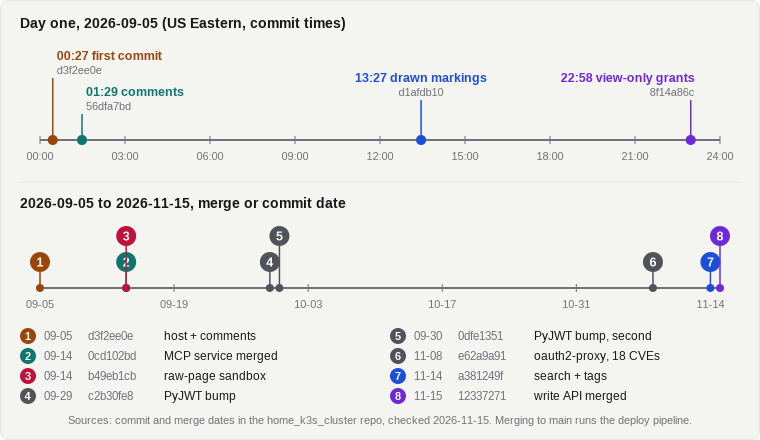
What it can’t back up is the exact thing I keep saying. I didn’t time a vendor’s security announcement against my own patch. What I do have is the patch record: a JWT library fix on 2026-09-29 and a second on 2026-09-30, and an oauth2-proxy bump on 2026-11-08 whose commit message says it covers 18 CVEs. Those are fixes I did on my own schedule, the day I noticed them. That’s the real benefit. I never had to wait for someone’s roadmap to find a gap in my own box.
The honest framing is that I’m not a day behind the industry because I’m fast. I’m a day behind because nobody else is in the way. If I’m busy or asleep, I’m as slow as anyone.
3. It includes being wrong in public
Minutes after I shipped comments, a review of that same work found I’d made an over-broad claim about my own sandbox. The sandbox isolated the framed copy of a page. The same bytes were also reachable as a top-level page, with the session cookie attached and no sandbox at all. I’d written that claim down in three places as the reason to loosen a policy next. The fix commit corrects all three and says the sandbox was “necessary, not sufficient.”
That top-level gap stayed open until a change called “sandbox raw artifact documents” on 2026-09-14, nine days later. The README now describes the sandbox as covering framed and top-level active documents.
Nine days is not “a day.” That’s the downside of owning the schedule: the same freedom that lets me ship a fix in a day lets me sit on one for nine.
What you give up
- Features you never have to think about. Hosted artifacts get things I won’t build. I have no version history in the UI (it’s on my planned list: the bucket already keeps versions, nothing shows them), and a design I maintain alone.
- Someone else’s on-call. My comments live in a single PostgreSQL replica on a small volume, with a nightly dump. I made the app survive a database outage by serving pages without comments, which is a good design and also a reminder that I’m the one who wrote that failure mode down.
- Someone else’s security team. Every dependency bump above was my job. A scope or a callback I get wrong is my incident.
- Ecosystem reach. My MCP server registers exactly two OAuth callbacks, one for Claude’s web connector and one for localhost. Anything else needs me to register it. That’s the intended safety property and also exactly why another assistant can’t just point at it.
- Time. All of this is hours that aren’t going into the things the pages are about.
If your reason for a share host is “I need to hand one page to one person,” use the hosted version. Mine started there, and a lot of what I built since is the part you’d pay a vendor to maintain.
Where I landed
I’m keeping the host for three reasons: the comment loop through MCP, an access list I can change without asking anyone, and the ability to patch or redesign the moment I care. The third one is real, and the dates show it. They also show the cost, because the same log has the nine-day gap and a long September night of hardening commits.
If you try this, build the access model first and the MCP server second, and give the MCP server less than you think it needs.